
What is Health Equity?
Health equity means that everyone has a fair chance to be healthy. This includes having access to the care, support, and services they need to stay well.
Some people face barriers to healthcare because of where they live, their income, their background, or other life factors. These barriers can affect how easily they get care and how healthy they are. At Stony Brook Eastern Long Island Hospital, we work to reduce these barriers, so all patients can receive high-quality care.
Our goal is to make sure care is fair, respectful, and available to everyone, no matter their race, ethnicity, income level, or personal identity.

Our Approach to Health Equity
Stony Brook Eastern Long Island Hospital takes a thoughtful and active approach to health equity. We focus on improving access to care, supporting our patients and community, and training our staff to meet the needs of people from all backgrounds.
 National Leader in LGBTQ+ Healthcare Equality
Stony Brook Eastern Long Island Hospital has been recognized as an LGBTQ+ Healthcare Equality Leader for 2026 by the Human Rights Campaign Foundation.
Stony Brook University Hospital, Stony Brook Children’s Hospital, Stony Brook Southampton Hospital, and Stony Brook Eastern Long Island Hospital all received a top score of 100 on the Healthcare Equality Index. This score reflects strong policies and practices in areas such as non-discrimination, staff training, patient services, employee benefits, and community engagement.
This recognition shows our commitment to providing safe, respectful, and inclusive care for LGBTQ* patients, families, and staff.
ASIST
 Stony Brook Eastern Long Island Hospital (SBELIH) has partnered with LivingWorks ASIST to offer free, two-day workshops for the East End community. These workshops teach suicide first aid, which means learning how to help someone who may be thinking about harming themselves.
The workshops include short lessons, small group discussions, and hands-on practice led by trained professionals in a safe, respectful, and supportive setting. Participants learn how to notice warning signs, how to talk with someone who may be at risk, and how to help create a safety plan to keep that person safe.
LivingWorks ASIST is a well-known suicide prevention training program used around the world. The program uses videos, group discussions, and real-life examples to help people understand what to do in difficult situations. It is designed for both professionals and community members.
LivingWorks ASIST has been teaching suicide prevention for more than 35 years and continues to update its training based on the latest research. This workshop is open to anyone who wants to help prevent suicide and support others in their community.
By offering this training, SBELIH and LivingWorks ASIST are working together to support the health and safety of the East End community. Learning these skills can help people step in, offer support, and save lives.
Click here to find a workshop near you.
CAST HEALTH FAIR
In partnership with CAST and the Town of Southold, Stony Brook Eastern Long Island Hospital (SBELIH) hosts a Free Annual Health Fair for the North Fork community.
The Health Fair helps connect people with local healthcare services and community resources. At the event, SBELIH shares information about many services, including behavioral health, nutrition, general surgery, cancer screenings, orthopedics, spine and sports medicine, and programs for older adults.
Community members can also meet representatives from local organizations that support health and well-being. Past partners have included health insurance providers, medical offices, community health centers, social service agencies, and safety programs such as Narcan training and vision screenings.
The Free Annual Health Fair gives people a chance to learn, ask questions, and find support close to home. Through this event, SBELIH works to strengthen community connections and help individuals make informed choices about their health on the North Fork.
FOOD AS MEDICINE
Stony Brook Eastern Long Island Hospital is committed to helping patients with health needs that go beyond medical care. One important challenge many patients face is food insecurity, which means not always having enough healthy food. A Health Equity Project was initiated by screening patients for food insecurity. Among those screened, approximately 10.4% were identified as food insecure.
To help address this need, SBELIH created and now offers a program called Food As Medicine. This program supports patients who may have trouble getting enough food after leaving the hospital. Patients identified as food insecure receive a tote bag filled with essential food items when they are discharged. The hospital also helps connect patients with local community resources for continued food support.
SBELIH works closely with the Center for Advocacy, Support, and Transformation (CAST) of the North Fork and Shelter Island. Through this partnership, patients in the area can access CAST’s local food pantry after leaving the hospital. The pantry helps many individuals and families get the food they need to stay healthy.
Good nutrition plays an important role in healing and recovery. The Food As Medicine program helps lower the risk of health problems after discharge and supports patients as they return home. Through programs like this, SBELIH addresses both medical care and everyday needs, helping to build healthier and stronger communities.
FOOD RESCUE US NORTH FORK
 Food Rescue US North Fork works to reduce hunger and food waste in communities across the country. The organization brings people together through trained volunteers who help deliver extra food to those who need it most.
Local volunteers work with restaurants, grocery stores, and community partners, including Stony Brook Eastern Long Island Hospital, to collect safe, unused food. This food would otherwise be thrown away. Volunteers quickly deliver the food to nearby social service agencies, where it can be shared with individuals and families facing food insecurity.
By rescuing food before it goes to landfills, Food Rescue US North Fork also helps protect the environment. Keeping food out of landfills reduces waste and lowers harmful emissions.
Stony Brook Eastern Long Island Hospital is proud to partner with Food Rescue US North Fork by donating freshly prepared and packaged food. Through this partnership, food is delivered to local organizations such as CAST in Southold, helping support neighbors in need across the North Fork community.
Stony Brook Eastern Long Island Hospital Reduces Food Waste While Feeding Those In Need
LGBTQ*
 Stony Brook Medicine has created an LGBTQ* Committee to better support the needs of LGBTQ* patients. Stony Brook Eastern Long Island Hospital is an active member of this committee.
The committee includes healthcare providers, nurses, behavioral health specialists, educators, students, and staff from many departments. Together, they work to make sure care is welcoming, respectful, and sensitive to the needs of LGBTQ* individuals.
The committee’s goal is to understand and address the unique healthcare needs of LGBTQ* patients. This work helps ensure that all patients receive fair and respectful care, no matter their sexual orientation or gender identity.
At Stony Brook Eastern Long Island Hospital, we are committed to creating a safe and welcoming environment for everyone. Our care teams treat every patient with dignity and respect, including those who identify as LGBTQ*.
Our providers also have experience caring for LGBTQ* patients, including adults with specific healthcare needs. They work to make sure each patient feels heard, understood, and supported throughout their care.
Through the work of the LGBTQ* Committee and our dedicated healthcare teams, Stony Brook Medicine continues to provide inclusive, high-quality care for the LGBTQ* community.
NARCAN
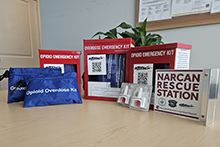 Narcan, also called naloxone, is a medication that can quickly reverse an opioid overdose. It is given as a nasal spray and can save a life in an emergency.
To make Narcan easy to access, the Narcan Rescue Station program was created. This program is the first of its kind on Long Island. Narcan Rescue Stations are provided free of charge to local businesses in the Town of Southold as part of a shared commitment to community safety.
More than 20 Narcan Rescue Stations are now located throughout Southold Town. This work continues through the efforts of Stony Brook Eastern Long Island Hospital (SBELIH), Rich Vandenburgh of Greenport Harbor Brewing Co. and former president of the Greenport Village Business Improvement District, and Tina Wolf, Executive Director of Community Action for Social Justice (CASJ). The program began in 2021 after the tragic loss of six community members to fentanyl-related overdoses.
The stations are placed in easy-to-find locations, such as Southold Town Hall, near the AED and Town Clerk’s Office. Each station includes two doses of Narcan, clear instructions for use, and fentanyl test strips to help improve safety. Local businesses and organizations help check and restock the stations so they are ready when needed.
Free training is also offered by Community Action for Social Justice (CASJ). These sessions teach people how to recognize an overdose and how to use Narcan correctly. Stony Brook Eastern Long Island Hospital proudly supports this training and the Rescue Station program as part of a community-wide effort to prevent overdose deaths.
Narcan Rescue Stations can be found in schools, businesses, and community spaces across the area, including the Mattituck, Southold, and Greenport School Districts, as well as locations such as Claudio’s, Ellen’s on Front, and Greenport Harbor Brewing Co. Additional stations are planned for places like the Mattituck Park District, Suffolk Cooperative Library System, Peconic Bay Yacht Club, and Silver Sands Motel.
Through partnerships and community action, this program helps make lifesaving care available when and where it is needed most.
Confidential in-home training is now available by calling (866) 599-7260 or info@nysocialjustice.org.
RECOVERY HOMES
Recovery homes help people continue their recovery after completing addiction treatment. These homes provide a safe, supportive place for individuals as they work toward a healthy and stable life.
Stony Brook Eastern Long Island Hospital operates three recovery homes in the Town of Southold. Each home has space for 10 residents. These homes show SBELIH’s commitment to supporting people as they move forward in their recovery.
Residents live in a drug- and alcohol-free environment that encourages healing and personal growth. A key part of recovery homes is peer support. People living together often share similar experiences and support one another through encouragement and accountability.
Recovery homes also focus on building important life skills. Residents learn skills that help them return to daily life, such as maintaining routines and making healthy choices. Trained staff members are available to provide guidance and support based on each resident’s needs.
By offering a safe environment, peer support, life skills training, and professional guidance, recovery homes give individuals the tools they need for long-term recovery. As communities continue to face challenges related to substance use, recovery homes remain an important part of helping individuals heal and rebuild their lives.
SAFE HAVEN FOR BABIES
Stony Brook Eastern Long Island Hospital is a Safe Haven location. The Safe Haven program helps protect newborns and supports pregnant individuals who may be in crisis.
Safe Haven offers a safe and legal option for parents or caregivers who feel unable to care for a newborn. The program allows a baby to be left in a safe place without fear of judgment or legal trouble. The goal is to keep both the newborn and the parent safe.
A parent, guardian, or any person caring for a newborn up to 30 days old may bring the baby to the hospital or another approved emergency location. The person may remain anonymous and will not be questioned.
Once the hospital is notified, staff work with licensed agencies to make sure the baby is cared for and placed in a safe home. Through the Safe Haven program, Stony Brook Eastern Long Island Hospital provides protection, support, and compassion during a difficult time.
For more information visit: https://ocfs.ny.gov/programs/safe/